

Cathy Hufford’s One Remarkable Match
Changes Two Lives
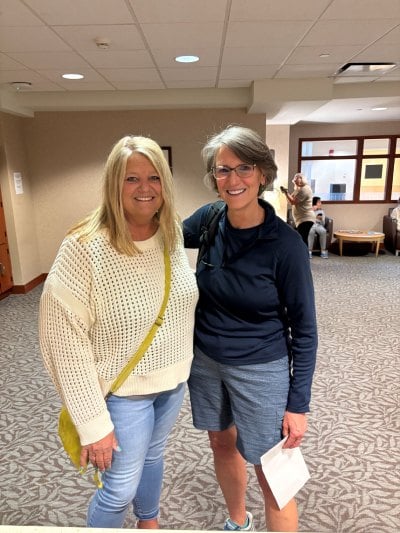
Cathy Hufford had sworn off Facebook. Between the dog rescues and horse rescues crowding her feed, she was spending too much time — and probably too much money — trying to help. Then, on a cold January night last year, unable to sleep, she logged on.
A woman who’d once worked for her had shared a post from a friend named Lisa: a plea for a kidney, after no one in Lisa’s own family was a match. Hufford, who had never met Lisa, read it once and knew. “I’m going to be her donor,” she remembers thinking. “I’m going to be a match.” That very night, she clicked the QR code for Loyola’s transplant program.
The certainty makes more sense given where she came from. The sixth of seven kids in a Catholic family in Iowa, Hufford grew up in a house where helping was simply what happened, whether volunteering at church, food pantries or soup kitchens, or helping neighbors shovel walks and cut grass. “You just pitched in and helped, and you didn’t think anything of it.”
Decades later, prosecuting criminal cases for Cook County from 1991 to 2020, she found the same instinct at the job’s center: “You can never make somebody who’s been a victim of a crime whole again,” she says. What she offered instead was some sense of justice and a voice, in a system that too often doesn’t listen.
That underdog advocacy stayed with Hufford, as she went through the process of becoming an organ donor including blood draws, scans, and a psychologist confirming no one had paid her to do this. At every step, someone reminded her she could still back out, right up until she was sedated. “I’m not changing my mind,” she told them.
It wasn’t bravery, exactly, that carried her through it. Thirteen prior orthopedic surgeries had already worn the fear of surgery out of her. If anything, it was her friends in medicine, who understood the risks best, who hesitated on her behalf.
The match was confirmed April 1. Surgery was scheduled for April 30, three days before Lisa’s own birthday. Donor and recipient met in person for the first time forty-eight hours before they were wheeled into adjoining operating rooms. Hufford was discharged Thursday afternoon and Lisa, whose recovery was longer, asked to be moved into Hufford’s old room.
What lingers more now is a ritual, not the scar. To protect the kidney she has left, Hufford drinks a gallon of fluids a day, mapped out in ounces before ten, before two, before supper, and carries a water bottle everywhere she goes. She gave up soda.
Lisa struggled, for a while, with the arithmetic of it. Why her, when so many others were still waiting and her own body would have rejected roughly forty percent of potential donors.
“It was just meant to be,” Hufford kept telling her. The two marked the three-month, six-month, and one-year kidney anniversaries. “I’m taking good care of your little kidney,” Lisa still texts her.
The donation brought Hufford an unplanned second gift. A former Chicago detective she’d known for thirty years read about her selflessness and messaged her. A double-lung transplant recipient himself, he understood exactly what she’d done. He offered to take her anywhere she wanted for dinner in Chicago, and Hufford chose her favorite hole-in-the-wall pizza place on the South Side. They talked until the restaurant closed and are now a couple.
Hufford still won’t call any of it remarkable. Asked what it cost her to give a stranger a kidney she shrugs it off the way she always has: “It’s really not a big deal. I did have two.” And somewhere between a midnight Facebook post and a South Side pizza place, one search for a match turned into two.