

Erica Hokens: Clay, Cases, and the South Side
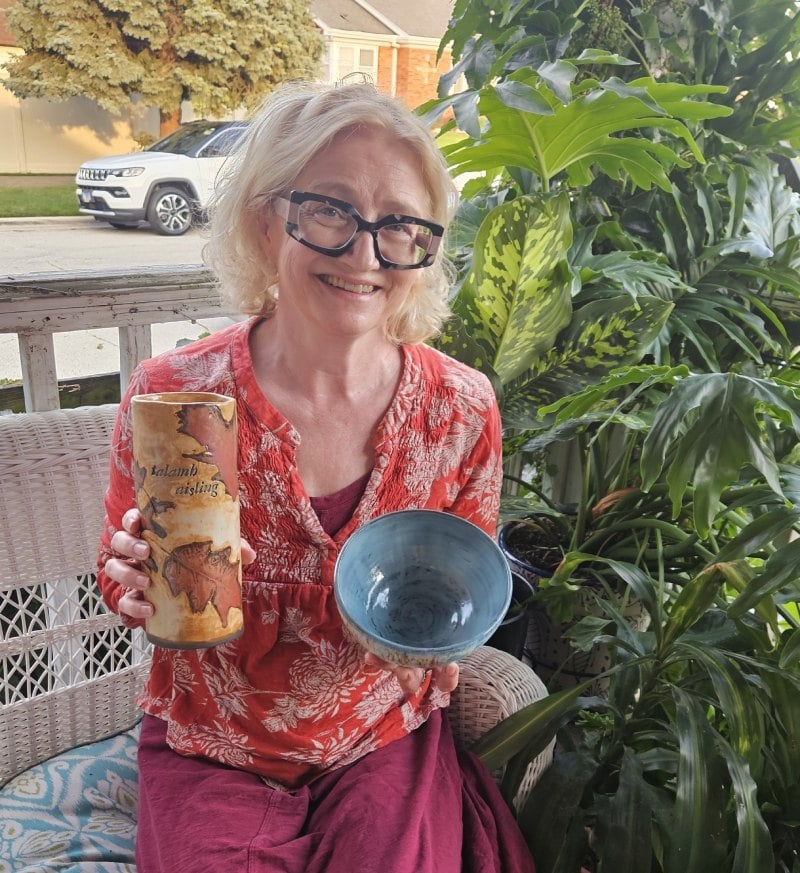
Growing up, Erica Hokens was surrounded by art. Her father was a freelance illustrator whose primary client was the Playboy music page. Later, he worked as a photographer, shooting for Encyclopedia Britannica and documenting Chicago street life: protesters at the 1968 Democratic Convention, musicians at Grant Park, and the vanishing architecture of Woodlawn. Art was the atmosphere of her childhood, even though she ended up in law.
Hokens has been with the City of Chicago’s Law Department for 26 years, the last seven as a Streets and Sanitation prosecutor, handling hearings downtown and at a site on 95th and Jeffery, two miles from the house she grew up in. The work is not glamorous, but what keeps her engaged is the detective work underneath it. When a respondent claims they don’t own the ticketed property, Hokens digs in herself: pulling deeds, checking recording dates, reading the photographs carefully. There are no investigators assigned to her unit; she is the investigator.
Before landing in Streets and Sanitation, her career moved through federal civil rights jury trials, drug and gang house enforcement (paired with police officers, always in motion, never behind a desk), and administrative hearings. What has kept her with the city across all those roles, she says, is variety and the fact that she is done when she leaves at the end of the day.
About four and a half years ago, Hokens started taking ceramics classes at the nearby Beverly Arts Center. Initially, she sat in front of the lump of clay, uncertain what to do with it. But she kept going back until she did.
What drew her in, she discovered, was the same thing that intrigued her as a child: the intersection of science and art. Hokens joined glaze chemistry groups online, studied how different clay bodies absorb moisture, learned why some glazes run in the kiln while others hold. The analytical instinct she brings to a complicated property dispute turns out to be useful when you’re trying to understand what happens to celadon at cone 6. “It’s a combination of both art and science,” she says.
She mostly hand-builds because she is drawn to organic shapes, and favors glazes in blues and greens that she layers and combines. The moment the kiln opens after a firing is always a surprise, which for Hokens, is a large part of the point. Her father used to develop his own photographs in a darkroom, burning in the light, adjusting the exposure by hand. The surprise of the developing tray, Hokens says, is not so different from the surprise of the kiln.
Most of what she makes is utilitarian: bowls, cups, plates. Nearly everything lives in her own cupboards, used daily, but she has also given mugs and other items she’s created as gifts.
While the Beverly Arts Center’s ceramics program has been suspended for the time being, Hokens has not stopped making pots. She is doing it from home now, with her own clay while she figures out where to fire next.
The two parts of her life the prosecutorial and the ceramic don’t overlap much, and Hokens prefers it that way. Ceramics is where she goes when she doesn’t want to think about law. But her father’s artistic eye, she says, is probably in there somewhere. Even if she couldn’t tell you exactly where.