

Beth Brooks Bets on Nurses
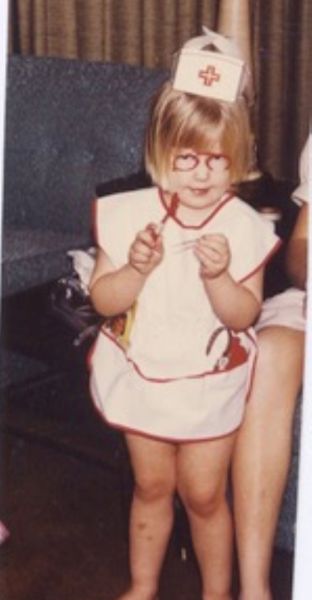
At three years old, Beth Brooks dressed as a nurse for Halloween. In the photo you see her in her tiny uniform, with plastic stethoscope and total certainty. In hindsight, the trajectory seemed almost inevitable. Years later, in a nursing leadership class, she thought, almost matter-of-factly, “I think I’m going to be the vice president of nursing someday.”
She was. But Brooks has never really followed a five-year plan. Her career, while richly rewarding and diverse, has rarely followed a straight line.
She began in traditional nursing roles but quickly moved into administration. From there, Brooks stepped into advertising and marketing, then into a dot-com startup focused on patient education. She wrote to the CEO herself after reading about the company and asked if they had a nurse on the team. They did not, so she joined.
Career opportunities often appeared because she was willing to say “yes.” Risk was easier to shoulder because as long as she kept her nursing license current, she could always return to clinical work.
Over time, Brooks became what she describes as a “fix-it” leader. Organizations brought her in to assess what wasn’t working, build the right team, implement change, and then she’d move on to the next challenge. She worked across health systems, higher education, staffing agencies, and faculty roles, observing healthcare from nearly every angle.
That breadth prepared her to lead a university owned by a health system. Brooks had to navigate two highly regulated, politically sensitive worlds at once. The education accreditor demanded independence. The health system expected alignment. And she had to speak the language of both. In her role as university president, all of the disparate chapters of her career converged: advertising, clinical leadership, academic experience, and operational oversight.
That pattern of convergence set the stage for her career pivot to venture capital. The idea for Nurse Capital didn’t originate in a boardroom. It came from a question posed by a younger nurse entrepreneur: Why don’t nurse leaders invest in nurse innovators?
Brooks understood the gap. Too often, she had seen healthcare startups built by people who have never worked at the bedside. They would design solutions first without understanding whether they solved an existing problem.
Nurses operate in the reverse. They live with problems every day; MacGyver workarounds; and invent out of necessity.
Brooks and her partner realized they were onto something, so they built their own venture capital fund. The model is simple but unusual: nurses investing in nurses. Before asking others to invest, they invested their own money to have skin in the game. Their limited partners are primarily nurse executives.
Deal flow has been brisk. Nurse Capital now has more than a hundred nurse entrepreneurs in its database. Many came through word of mouth. No splashy marketing campaign was needed, just a professional grapevine that is far more powerful than most outsiders would assume.
When evaluating founders, Brooks and her partner look beyond the pitch deck. They seek leadership, resilience, and the ability to switch hats from clinician to business builder. They want founders whose priorities focus on improving patient care and supporting nurses’ workflows.
Venture capital in this space doesn’t produce overnight wins. Healthcare adoption is slow and regulatory pathways are long. Nurse Capital is comfortable with that. Multiples matter, but impact is measured by whether care becomes safer, more efficient, and more humane.
Brooks, who writes a long-running career coaching column for Nurse Leader, says that had she not stepped into venture capital, she would likely be teaching more. Instead, she is helping shape a generation of nurse entrepreneurs who are determined to build their own solutions.
If nurses control capital, they can reshape power—just as Beth Brooks has done.