

kt williams Is Interested in What Dance Does
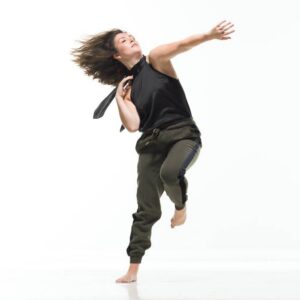
Before audiences encounter the work of choreographer and dancer kt williams, they often encounter her name—written deliberately in lowercase. That choice is neither accidental nor purely aesthetic. It reflects how kt moves through the world as an artist: less interested in hierarchy or spectacle than in process, collaboration, and presence. While known professionally as “kt,” close friends and family still call her “Katie,” a duality she embraces rather than resolves.
From the beginning, kt has been less concerned with what dance looks like than with what it does—how bodies gather, how trust is built, and how something meaningful emerges from collaboration over time. She is drawn to the way dances are made, not just how they appear onstage.
During her undergraduate training at the University of Illinois at Urbana-Champaign, she encountered a more experimental, process-centered approach to choreography. Full-length works developed over months of shared inquiry, improvisation, and relationship-building. What resonated with kt was the experience of making the dance: the vulnerability required, the collective decision-making, and the sense that a group of people could model a different way of working together.
That sensibility continues to shape kt’s democratic practice as a choreographer, performer, teacher, and filmmaker. Based in Chicago, kt is known for creating collaborative environments where dancers contribute their own histories, movement languages, and perspectives. The work evolves as new bodies enter, reflecting the people performing it in that moment.
A cornerstone of kt’s work is Safety Release, a somatic approach to contemporary dance that emphasizes spinal mobility, joint articulation, and the release of unnecessary tension. She was introduced to the practice while in graduate school at the University of North Carolina at Greensboro, where she studied with its founder, B.J. Sullivan. Now one of only six Safety Release Master Teachers in the world, kt is drawn to the practice’s repetitive, meditative entrance into the work, which invites dancers to study their own bodies and internal states to let go of extraneous tension before moving into more demanding work.
Safety Release informs her teaching, and kt’s choreography draws more broadly on its somatic principles. Rather than prescribing exact steps, she offers cues that invite dancers to imagine sensation, allowing movement to emerge organically.
That openness extends beyond the studio. Through DanSeries Collective, a collaborative duo she co-founded with North Carolina-based choreographer Caitlyn Schrader, kt and Caitlyn bring dance into public spaces not typically associated with performance: gas stations, parking decks, shopping malls, and city sidewalks. These site-specific pop-ups aren’t intended as spectacle, but as moments of interruption—brief encounters that invite curiosity, humor, and connection.
Filmmaking is another extension of kt’s interest in perspective. Without formal film training, she began creating dance for the camera during the pandemic, drawn to the way editing could become its own form of choreography. Close-ups, unconventional angles, and rhythmic cuts allow her to offer audiences an intimacy impossible in live performance, turning the screen into another site of experimentation.
Despite the constant hustle of teaching, rehearsing, applying for opportunities, and sustaining long-distance collaborations, kt remains deeply committed to her work. She resists conventional markers of success, instead measuring progress through relationships, reciprocity, and moments of quiet recognition—when a piece becomes its own entity, and she feels her chest soften with the certainty that something is right.
For kt williams, dance isn’t about a destination. It’s about staying open—to process, to people, and to the possibility that transformation emerges through working together.
To learn more about kt and her practice, visit her website: ktwilliamsdance.com